Published · By Frank DeLozier, Owner & Master Fence Builder
Fence height limits differ by city and by where the fence sits, back, front, or a corner lot, so confirm yours before building.
How tall a fence can be in Oklahoma depends on your city and where the fence sits. Back and side yards commonly allow up to about six feet (sometimes eight), while front yards are usually limited to roughly three to four feet, and corner lots have sight-triangle limits near the intersection. Rules vary by city, so verify locally.
How Tall Can a Fence Be in Oklahoma?
There is no single statewide fence height, because height is set by each city’s zoning code, and it changes based on where the fence is on your lot. The general pattern across the metro is that back and side yards allow taller fences than front yards, and corner lots have their own limits for traffic safety.
The common figures below are typical tendencies, not your city’s exact rule. Because the specifics vary and can change, always confirm the current limits with your municipality before building, or work with a fence company that builds to code as part of the job.
Back and Side Yard Height Limits
Back and side yards are where the tallest fences are allowed, since privacy is the point and there is little traffic-safety concern. Many cities permit fences up to around six feet in these areas without special approval, and some allow up to eight feet.
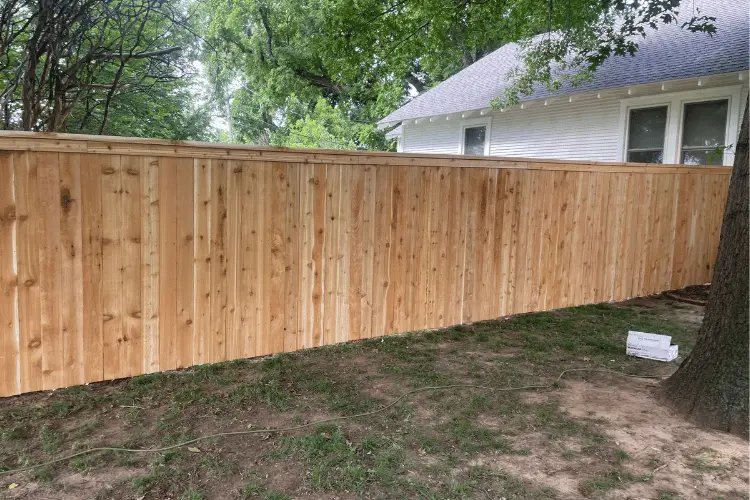
Six feet is the most common privacy-fence height in the metro for exactly this reason, it satisfies most back-yard rules while giving good privacy. If you want eight feet, check whether your city allows it outright or requires a permit or variance, since that is often where the threshold sits.
Front Yard Height Limits
Front yards are more restricted. To preserve sightlines, curb appeal, and neighborhood character, cities commonly limit front-yard fences to a lower height, often in the three-to-four-foot range, and sometimes require a more open style rather than a solid privacy fence.
This is why you see decorative iron, low picket, and open fences out front rather than tall privacy walls. If you want a taller or more solid front-yard fence, it usually requires special approval, and an HOA may restrict it further, so front-yard fencing is the area to check most carefully.
Corner Lots and the Sight Triangle
Corner lots get an extra rule: the "sight triangle" or "visibility triangle" at the intersection. This is a corner area that must be kept low, typically only a short fence or none at all, so drivers and pedestrians can see approaching traffic. It is a safety rule, and cities enforce it.
For a corner-lot owner, this commonly means the fence has to step down to a low height near the corner even if the rest of the yard allows six feet. It catches a lot of people by surprise, so if you are on a corner, confirm the sight-triangle rule before you plan your fence line.
Why Cities Limit Fence Height
The rules are not arbitrary. Height limits balance a few interests: privacy and security for homeowners, sightlines and safety at streets and intersections, and the look and openness of a neighborhood. Front-yard and corner limits lean toward visibility and appearance; back-yard allowances lean toward privacy.
Understanding the reasoning helps make sense of why the same fence height is fine in one spot and not another on the very same lot. The rules follow the purpose of each area of the property.
HOA Rules Can Be Stricter Than the City
City height limits are the floor, not the whole story. If you live in an HOA neighborhood, the HOA can, and often does, set stricter or more specific rules than the city, dictating a maximum height, a required material or style, and the finished-side direction.
You have to satisfy both. A fence can meet the city’s six-foot allowance and still violate an HOA rule that caps it lower or requires a particular look. In HOA neighborhoods, check the HOA’s architectural guidelines alongside the city code before you build.
What If You Want to Exceed the Limit?
Sometimes you have a good reason to want a taller fence than the code allows, backing to a busy road, for instance. In that case, cities typically have a variance process: you apply for permission to exceed the standard limit, and the city reviews it. Approval is not guaranteed and takes time.
It is a legitimate path when justified, but it is a process, not a given. Building over the limit without approval risks a stop-work order or an order to bring the fence into compliance, so if you need extra height, go through the variance rather than around it.
Pool Fences Have Different Rules
If a fence is enclosing a pool, safety code takes over. Pool barriers are generally required to be at least a minimum height (commonly 48 inches) with limited gaps and self-closing, self-latching gates, requirements aimed at keeping children away from the water.
These pool-barrier rules are about safety, not the general fence-height code, and they apply on top of it. Our pool fence page and pool-code guide cover those requirements, which are stricter and non-negotiable.
Barbed Wire and Electric Fence Rules
Height is not the only thing cities regulate; the type of fence matters too. Many municipalities restrict or prohibit barbed wire and electric fencing in residential areas for safety reasons, even below the standard height limit. These are typically allowed on agricultural or rural-zoned property, where they do their job containing livestock, but not around a suburban backyard.
If you own acreage on the metro’s rural fringe, barbed wire and electric fence are usually fine and common. If you are in a residential neighborhood, check before assuming you can top a fence with barbed wire or run an electric strand, since local code often says no.
Fence Height on a Slope
Sloped lots add a wrinkle to the height rules. As a fence follows a grade, it is either stepped, each section level and staggered down the slope, or racked, angled to follow the ground continuously. How the city measures height on that slope, from the high side, the low side, or the average, can affect whether a section is over the limit.
Retaining walls complicate it further, since a fence on top of a wall may be measured from the base of the wall or the top, depending on the code. On a flat yard none of this matters, but on a slope or with a wall, it is worth confirming how your city measures so you do not accidentally exceed the limit on the downhill side.
How Is Fence Height Measured?
Height is generally measured from the ground to the top of the fence, but the ground reference can matter on a slope, and some cities measure from the higher or the average grade. Posts or decorative post caps that rise above the fence panels may or may not count, depending on the code.
These measurement details rarely trip up a standard flat-yard fence, but on a sloped lot or with a decorative topper, they can. If your project is close to a height limit, it is worth confirming exactly how your city measures it.
How We Build to Code
When we build your fence, staying within the height rules is part of the job. We know the metro cities we work in, build to the allowed heights for your yard and lot type, handle the sight-triangle limits on corner lots, and provide the documentation permits and HOAs require.
That means you get the tallest, most private fence your rules allow, built compliant, without you having to decode zoning language. If a variance would help your situation, we can point you toward that too.
Get a Free, Code-Compliant Fence Quote
We come to your property anywhere in the OKC metro, walk your project, and build to the height rules for your city and lot, handling permits and HOA approval as part of the job. Every install carries a one-year workmanship warranty.
Call us at (405) 767-4828 or request a free quote to get started.
Good to Know
Frequently Asked Questions
It varies by city, but back and side-yard fences are commonly allowed up to around six feet (sometimes eight), while front-yard fences are typically limited to roughly three to four feet. Corner lots have sight-triangle limits near the intersection. Always confirm your city’s exact rules.
Front-yard fences are usually limited to a lower height than back yards, commonly in the three-to-four-foot range, to preserve sightlines and appearance, and often must be a more open style. A taller or solid front fence typically needs special approval, and HOAs may restrict it further.
Sometimes. Some cities allow up to eight feet in back and side yards outright, while others cap fences at six feet or require a permit or variance above that. Since eight feet is often where the threshold sits, confirm your city’s rule, and any HOA limit, before planning one.
Generally from the ground to the top of the fence, though on a slope some cities measure from the higher or average grade, and whether tall posts or caps count can vary. These details rarely affect a flat-yard fence, but confirm them if your project is close to a height limit.
Keep Reading
Explore Our Fence Services