Published · By Frank DeLozier, Owner & Master Fence Builder
Board-on-board gives full privacy; shadowbox looks good from both sides and lets wind through.
Board-on-board overlaps pickets so there are no gaps, giving full privacy and a solid look, but it catches more wind. Shadowbox alternates pickets on opposite sides of the rails, so it looks good from both sides, lets wind pass through, and offers near-privacy with slight angled gaps. The choice hinges on privacy versus airflow and two-sided appearance.
Two Upgraded Privacy Fence Styles
Board-on-board and shadowbox are both step-ups from a basic side-by-side privacy fence, and homeowners building a nicer wood fence often weigh one against the other. They look different, perform differently in wind, and handle the "good side" question differently, so understanding each helps you pick the right one.
Both are quality wood privacy styles, and neither is simply better; they suit different priorities. If you want maximum, gap-free privacy, one leans ahead. If you want a fence that looks the same from both sides and breathes in the wind, the other does. This guide lays out the differences.
What Is a Board-on-Board Fence?
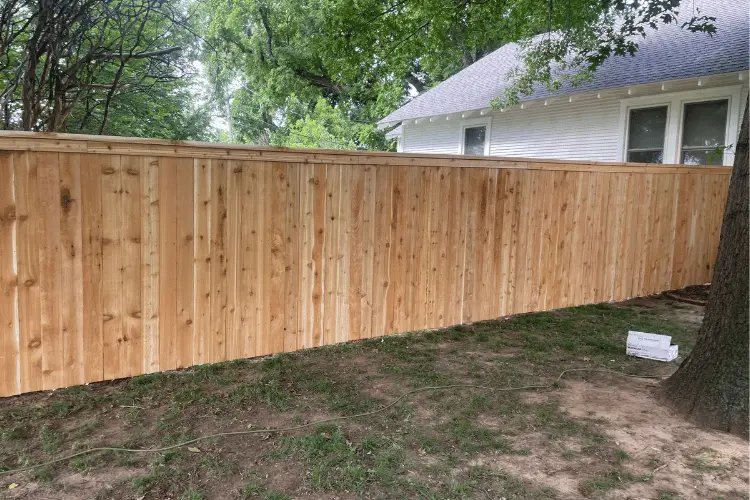
A board-on-board fence (sometimes called overlapping) mounts pickets so that each board overlaps its neighbors, with boards on alternating positions that overlap at the edges. The result is a fence with no gaps, even as the wood expands and contracts, and a rich, dimensional, high-end look thanks to the layered boards.
The overlap is the key feature: because the boards cover each other’s edges, there is no line-of-sight gap now or later. This makes board-on-board the choice for full, lasting privacy, and its layered construction gives it a substantial, upscale appearance that a flat side-by-side fence does not have.
What Is a Shadowbox Fence?
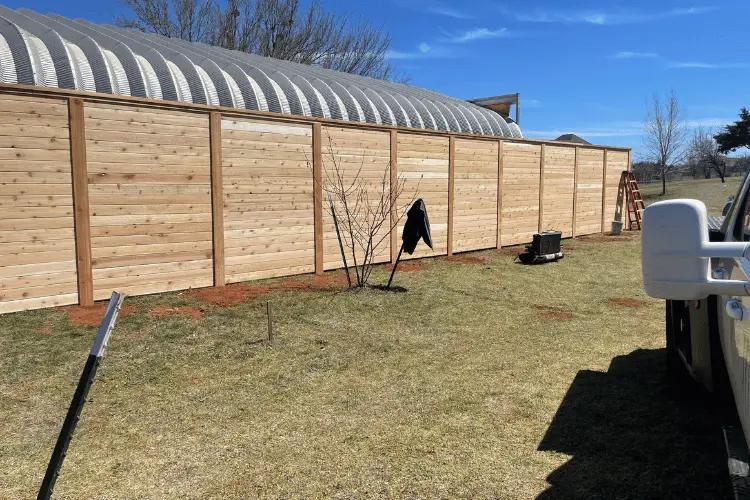
A shadowbox fence (also called good-neighbor) alternates pickets on opposite sides of the rails, one board on the front, the next on the back, and so on down the fence. The boards overlap when viewed head-on but leave small gaps when viewed at an angle, creating a semi-private fence that looks essentially identical from both sides.
That two-sided symmetry is shadowbox’s signature: neither neighbor gets stuck with the "bad side" showing the rails and posts, because the alternating pattern presents the same finished look each way. The small angled gaps also let air, and some light, pass through, which has real advantages in wind.
Privacy Compared
On pure privacy, board-on-board wins. Its overlapping boards leave no gaps, so there is no seeing through it straight on or at an angle, now or after the wood moves with the seasons. If complete privacy is the priority, board-on-board delivers it most reliably.
Shadowbox provides near-privacy: looking straight at it, the overlapping boards block the view, but at an angle the small gaps allow partial sightlines. For most backyards this is plenty of privacy, but it is not the total, gap-free screening of board-on-board. So the privacy question is really full versus near-full.
Appearance From Both Sides
This is shadowbox’s standout advantage. Because it alternates boards on both sides of the rails, it looks the same, finished and attractive, from both your yard and your neighbor’s. There is no unsightly "rail side," which makes it the "good-neighbor" fence and can prevent disputes about who faces the framework.
Board-on-board, by contrast, has a front and a back; the overlapping-board face is the show side, and the other side shows more of the structure. It is still an attractive fence, but it is not symmetrical the way shadowbox is. If both sides being equally presentable matters, shadowbox has the edge.
Wind Resistance
Oklahoma wind makes this a real consideration. Shadowbox, with its small gaps, lets wind pass through rather than catching it like a solid wall, which reduces the load on the fence and its posts during our high winds. That airflow is a genuine benefit in a windy climate.
Board-on-board, being solid with no gaps, catches more wind, essentially acting as a windbreak, which puts more force on the posts. That does not rule it out at all; it just means a board-on-board fence must be built for wind, with posts set deep and solidly. Our wind-resistant fence guide covers the principles, but all else equal, shadowbox handles wind more easily.
Airflow and Your Yard
Beyond structural wind load, airflow affects your yard. Shadowbox’s gaps let a breeze move through, which can keep a yard feeling less stuffy and help with air circulation for plants and comfort. Some homeowners value that a solid fence does not box the yard in completely.
Board-on-board blocks airflow along with sightlines, which is exactly what you want for total privacy and wind-blocking, but it does trap air more. Neither is right or wrong; it depends on whether you want an open-breathing yard (shadowbox) or a fully enclosed, private one (board-on-board).
Cost Comparison
Both styles use more lumber than a basic side-by-side privacy fence, board-on-board because of the overlapping boards, shadowbox because of boards on both sides, so both cost more than the simplest privacy fence. Between the two, the cost is often comparable and depends on the specific design and materials.
Rather than quote figures that would not fit your project, we price your specific fence, but expect both of these upgraded styles to cost more than a plain privacy fence and to be in a similar range to each other. The choice between them is better made on performance and looks than on a small price difference.
Maintenance and Longevity
Both are wood fences and share wood’s maintenance needs, periodic cleaning and sealing or staining to protect the wood and preserve its look. Neither style is dramatically more maintenance than the other; both come down to the wood used and how well it is cared for.
As with any wood fence, longevity depends heavily on solid construction, posts set deep in concrete, quality wood, and good fasteners, and on staying on top of sealing. Our fence maintenance and staining guides apply equally to board-on-board and shadowbox. Build either one well and maintain it, and it will last.
One small practical note: because board-on-board uses more overlapping boards and shadowbox mounts boards on both sides, both styles have more individual pieces than a plain fence, which just means a little more surface to clean and seal at maintenance time. It is a minor point, and the payoff, gap-free privacy or a two-sided finished look, is well worth the extra boards for the homeowners who choose these styles.
Which Should You Choose?
Choose board-on-board if your top priority is complete, gap-free privacy and you love the rich, dimensional, upscale look of overlapping boards, and you are ready to build it stout for wind. It is the choice for maximum privacy and a premium appearance.
Choose shadowbox if you want a fence that looks great from both sides, lets Oklahoma wind pass through with less load on the posts, and provides near-privacy that suits most backyards. It is the good-neighbor, wind-friendly option. Both are excellent; the right one depends on how you weigh privacy against two-sided looks and airflow.
How We Build Privacy Fences
Metro Fence builds board-on-board, shadowbox, and other wood privacy fences across the OKC metro, on posts set deep in concrete to handle Oklahoma wind, with the construction that makes a privacy fence last. See our privacy fence and residential fence services for the styles we build.
We help you choose the privacy style that fits your priorities for privacy, appearance, and wind, then build it right. A free on-site estimate is always available.
Get a Free Privacy Fence Quote
We come to your property anywhere in the OKC metro, talk through board-on-board versus shadowbox and the look you want, and give you a clear quote. Every install carries a one-year workmanship warranty.
Call us at (405) 767-4828 or request a free quote to get started.
Good to Know
Frequently Asked Questions
Board-on-board overlaps pickets so there are no gaps, giving full, gap-free privacy and a layered, upscale look, but it catches more wind. Shadowbox alternates pickets on both sides of the rails, so it looks the same from both sides, lets wind pass through, and offers near-privacy with slight angled gaps.
Board-on-board is more private. Its overlapping boards leave no gaps, so there is no seeing through it straight on or at an angle, even after the wood moves seasonally. Shadowbox blocks the view head-on but has small gaps visible at an angle, giving near-privacy that suits most backyards but is not gap-free.
Yes, generally. Shadowbox’s small gaps let wind pass through rather than catching it like a solid wall, reducing load on the fence and posts, an advantage in windy Oklahoma. A solid board-on-board fence catches more wind, so it must be built with posts set deep and solidly to handle the load.
It usually refers to a shadowbox fence, which alternates boards on both sides of the rails so the fence looks the same, finished and attractive, from both yards. Neither neighbor is stuck facing the rails and posts, which is why it is called a good-neighbor fence and can help avoid disputes over the "bad side."
Keep Reading
Explore Our Fence Services