Published · By Frank DeLozier, Owner & Master Fence Builder
A cedar wood privacy fence is a mid-range fence in the OKC metro, more than chain link and less than ornamental iron, and it offers the best balance of privacy, looks, and value. Standard six-foot cedar is the most economical version, while cap-and-trim detailing, eight-foot height, steel posts, and extra gates push the price up. The only way to know your exact cost is a free on-site quote.
How Much Does a Privacy Fence Cost in Oklahoma City?
For most OKC-metro homeowners, a cedar wood privacy fence is a mid-range investment: more than a chain link fence, less than ornamental iron, and, most homeowners find, the best value for the privacy and curb appeal it delivers. The size of your backyard is the biggest driver of the total, followed by height, style, gates, and terrain.
Because every yard is different, we do not put a fixed price online, only a free, written on-site estimate. Cedar privacy is the most popular fence in the metro because it offers the best balance of privacy, appearance, durability, and cost, and your exact price depends on your yard.
What You Get at Each Price Point
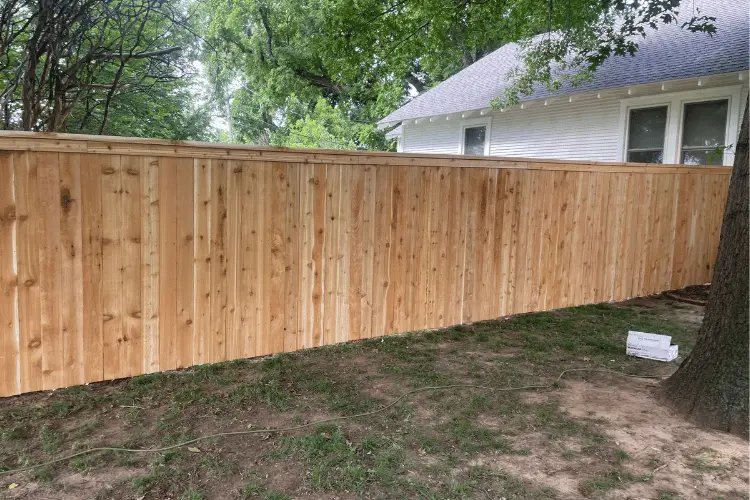
At the lower end, you get a clean six-foot cedar privacy fence: vertical pickets, posts set in concrete, and a dog-ear or flat top. It is private, solid, and built to last, and it is what most backyards need.
Moving up, board-on-board overlaps the pickets so there are no gaps as the wood moves, and cap-and-trim adds a top cap and trim board for a finished, custom look from the street. Higher still, an eight-foot fence, premium pickets, decorative tops, and galvanized steel posts add privacy, longevity, and curb appeal. Each step adds material and labor, which is what moves the per-foot price.
What Drives Privacy Fence Cost Up?
Height is the biggest single factor. An eight-foot fence needs taller posts set deeper, more pickets, and often an extra rail, so it costs meaningfully more per foot than a standard six-foot fence.
Style and material come next. Board-on-board uses roughly a third more pickets than a standard privacy fence, cap-and-trim adds lumber and labor, and premium cedar grades cost more than builder-grade. Gates add up too: a standard walk gate is modest, but wide drive gates and double gates involve extra hardware and bracing.
Finally, the site itself matters. Sloped lots that step or rack down, yards with lots of corners, rocky or clay soil that is hard to dig, and tear-out and haul-off of an old fence all add to the number. Oklahoma wind means posts placed to the proper depth, wet set in concrete, which is part of any fence that is going to last here.
Cedar vs. Cheaper Wood: Why Material Affects Cost
It is tempting to price a privacy fence on the cheapest lumber available, but wood choice changes both the up-front cost and the lifetime cost. Western Red Cedar naturally resists rot and insects and handles Oklahoma’s swings of heat, cold, and humidity, which is why it lasts longer than pine and stays straighter as it dries.
A cheaper pine or spruce fence can look similar on day one and cost less, but it often warps, cups, and needs replacement or heavy maintenance sooner. Spending a bit more per foot on cedar and on proper posts usually costs less over the life of the fence than building it twice.
Does a Privacy Fence Add Home Value?
A well-built privacy fence is one of the more reliable outdoor improvements for resale, because buyers see immediate value in a private, secure, pet- and kid-ready backyard. It rarely returns every dollar on paper, but it improves how fast and how well a home shows, especially in family neighborhoods across the OKC metro.
The key words are well built. A leaning, mismatched, or clearly bargain fence can read as deferred maintenance and work against you, while a straight, clean cedar fence with posts set in concrete adds real curb appeal.
How to Lower Your Privacy Fence Cost
There are smart ways to trim a privacy fence budget without cutting the parts that matter. Sticking with a standard six-foot height, a simple dog-ear top instead of cap-and-trim, fewer or narrower gates, and longer straight runs all reduce cost per foot.
What you should not cut is the foundation. Shallow posts, no concrete, and cheap fasteners are where a bargain fence fails, and fixing a failed fence costs far more than building it right the first time. We are happy to walk through options during a free estimate and find the build that fits your budget and your yard.
How Terrain and Tear-Out Affect the Price
Two site factors quietly move a privacy fence quote as much as the style you pick. The first is terrain. A flat, open backyard is the fastest to build, but a sloped lot has to be stepped or racked so the fence follows the grade cleanly, and that adds posts and labor. Rocky or heavy clay soil, common in parts of the metro, is slower and harder to dig, which also shows up in the price.
The second is tear-out. If an old fence has to come down first, removing it, pulling the old concrete-set posts, and hauling everything off is real work that a fair quote accounts for. Neither is a surprise when we measure in person, and both are reasons a quick phone estimate on a privacy fence is rarely accurate. Your yard’s specifics are what set the real number.
Common Privacy Fence Add-Ons
Beyond the base fence, a few popular additions affect the total. A cap-and-trim or lattice top adds a finished or decorative look, a kickboard or rot board along the bottom keeps the pickets off the dirt and extends their life, and matching arbors or a decorative gate can turn an entrance into a feature. Some homeowners add a horizontal-slat accent section or a galvanized steel-post upgrade on the windiest run.
Each is optional and priced on top of the fence, so you can add the ones that matter to you and skip the rest. During your estimate we walk through which upgrades are worth it for your yard and which are just extra cost, so your budget goes where it actually improves the fence.
Board-on-Board vs. Cap-and-Trim: Cost and Look
Two upgrades drive most privacy fence quotes above the base price, and it helps to know what each buys. Board-on-board overlaps the pickets so there is no gap between them, even as the wood dries and moves over the seasons. It uses roughly a third more cedar than a standard privacy fence, which is why it costs more per foot, but it delivers true, gap-free privacy that lasts.
Cap-and-trim is about the finished look. A horizontal cap board runs across the top and a trim board frames the pickets, hiding the end grain and giving the fence a clean, custom, architectural line from the street. It adds lumber and labor, so it costs more, but on a street-facing fence many OKC homeowners feel it is the detail that makes the fence look high-end. You can combine both for a top-tier fence, or pick one to prioritize privacy or curb appeal within your budget.
Privacy Fence Cost by Backyard Size
Total cost tracks footage, so backyard size is the fastest way to ballpark a project. A small city backyard might need only 120 to 150 feet of fence, a typical suburban lot 180 to 250 feet, and a larger or corner lot 300 feet or more. At cedar privacy rates, those translate to roughly the mid four figures on the small end up past ten thousand dollars on large lots, before gates and tear-out.
Treat those as planning figures only. Corner lots, sloped yards, and homes that only fence part of the property all shift the number, which is why we measure in person. The point is simple: more fence means more cost, and knowing your rough footage helps you set a realistic budget before we ever come out.
Gates and What They Add
Gates are priced on top of the per-foot fence because they are the hardest-working part of it. A standard walk gate needs its own posts, heavy hinges, and a latch, and a wide drive gate or a double gate for trailer and mower access needs bracing so it does not sag over time. Each gate adds hardware and labor, so two or three gates noticeably affect the total.
It is worth getting gates right rather than cheap, because a sagging, dragging gate is the first thing that fails on an otherwise good fence. We build gates square, hang them on quality hardware, and size them for how you actually use the yard.
Get Your Exact Privacy Fence Quote
We come to your property anywhere in the OKC metro, measure the yard, walk through your style and gate options, and give you a free, written, no-obligation estimate. Most privacy fences are finished in one to three days, and every install carries a one-year workmanship warranty.
Call us at (405) 767-4828 or request a free quote. If you would rather spread the cost, we partner with Tinker Federal Credit Union for fast fence financing.
Good to Know
Frequently Asked Questions
The cost of a six-foot cedar privacy fence depends on the length of the run, the style, the gates, and the terrain, so it varies from yard to yard. Cedar is a mid-range material, and a standard dog-ear fence is the most economical version. A free on-site measure gives you the exact number for your backyard.
Cap-and-trim adds a top cap board and trim, which means more lumber and more labor per foot than a plain dog-ear fence. Many homeowners feel the finished, custom look is worth the modest upgrade, especially on street-facing runs.
For most Oklahoma yards, yes. Cedar resists rot and insects and stays straighter than pine as it dries, so it lasts longer and looks better with less maintenance. Spending a little more on cedar and proper posts usually costs less over the life of the fence.
Most average OKC-metro backyards need roughly 150 to 250 linear feet of fence, and the total depends on that footage plus the height, style, number of gates, and terrain. Because those vary so much from yard to yard, we skip online price guesses and give you a free, exact on-site estimate.
Keep Reading
Explore Our Fence Services