Published · By Frank DeLozier, Owner & Master Fence Builder
A high-security fence is engineered to deter, delay, and detect intrusion, not just to mark a property line.
A high-security fence is built to resist climbing, cutting, and forced entry, not just to mark a boundary. It uses heavy-gauge, anti-climb, anti-cut construction, extra height (often seven to eight feet plus a top treatment), and features like palisade or welded mesh, barbed or razor tops, and integrated controlled entry.
What Defines a High-Security Fence?
A high-security fence does three jobs an ordinary fence does not: it deters intruders by looking formidable, it delays them by being genuinely hard to climb, cut, or breach, and it supports detection by working alongside cameras and lighting. Where a standard fence marks a boundary, a security fence is a real physical obstacle.
That difference shows up in the construction, heavier materials, greater height, anti-climb and anti-cut designs, and reinforced foundations, and in the features, tops, gates, and access systems built to keep a determined intruder out. This guide walks through what makes a fence high-security and which businesses need one.
Anti-Climb Construction
Making a fence hard to climb is central to security. Anti-climb designs remove the footholds and handholds that let someone scale a fence. Welded mesh with very small apertures, for example, gives fingers and toes nowhere to grip, and vertical-bar palisade fences offer little to hold onto.
Height reinforces this: the taller the fence, the harder it is to get over even with a foothold. Combined with a top treatment that makes the top edge hostile, anti-climb construction turns a fence from a quick hop into a serious obstacle that most intruders will not attempt.
Anti-Cut Construction
A fence is only as secure as its ability to resist being cut through. Ordinary chain link can be defeated with simple bolt cutters, so high-security fences use heavier gauges and designs that resist cutting, thick welded mesh, solid steel palisade pales, and reinforced framework that hand tools cannot quickly get through.
Anti-cut and anti-climb work together: a fence that cannot be climbed over or cut through forces an intruder to spend time and make noise, which is exactly what a security fence is meant to do, delay the breach long enough for detection and response.
Height and Top Treatments
High-security fences are tall, commonly seven to eight feet, and often topped with a treatment that makes going over the top dangerous and difficult. Angled barbed-wire arms, coils of razor ribbon, and spiked or rolled toppers all raise the effective height and the deterrent.
The top treatment is chosen for the site and what local code allows: barbed and razor tops are common on industrial and utility sites but restricted in many residential and some commercial areas. The right combination of height and top turns the fence line into a genuine barrier rather than a hurdle.
Common High-Security Fence Designs
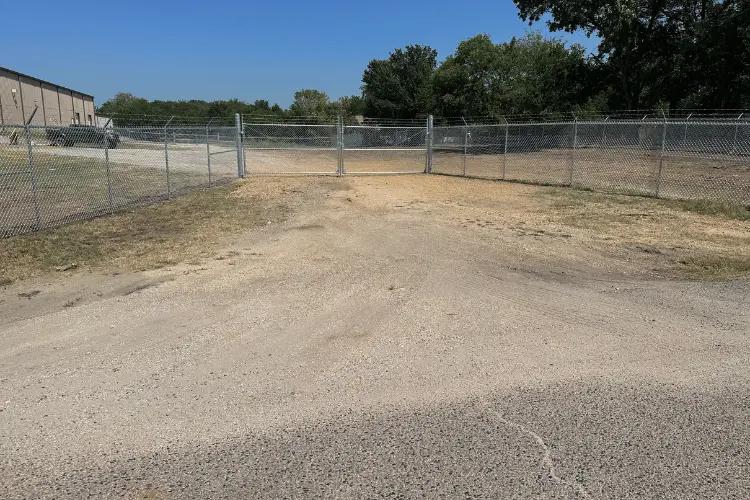
Several fence types serve high-security roles. Heavy-gauge commercial chain link, topped with barbed wire, is the workhorse for yards, utilities, and industrial sites, economical and effective. Welded wire mesh (often called anti-climb or "358" mesh) offers superior climb and cut resistance in a cleaner look.
Steel palisade fencing, vertical steel pales with pointed tops, is a strong, imposing option common on utility and infrastructure sites. Ornamental steel can provide security with a more finished appearance for commercial frontages. The right design depends on the threat level, the site, and the look you need.
Gates and Entrances
A security fence is only as strong as its gates. High-security sites use heavy gates, swing or cantilever slide, matched to the fence and sized and braced for the opening so the entrance is as solid as the perimeter around it.
The gate is the intended way in, so it gets the most attention. Heavy swing and cantilever slide gates, sized and braced for the opening and matched to the fence, let a facility control where vehicles and people enter. For many businesses, the gate is as important as the fence itself.
The Foundation: Posts and Footings
A tall, heavy security fence puts real load on its posts, from its own weight, from wind, and from anyone trying to force it. So the foundation matters as much as the fabric. High-security fences use larger posts set deep in substantial concrete footings, with braced corners and gate posts built to take the stress.
A fence that could be pushed over or pulled loose is not secure no matter how anti-climb the mesh is. Building the posts and footings to carry the load is part of what separates a genuine security fence from a tall fence that looks the part.
Integrating Fencing With Cameras and Lighting
The best security is layered, and a fence is one layer that works with others. High-security perimeters are designed to complement cameras, motion sensors, and lighting: the fence delays the intruder, and the detection systems catch them in the act while there is time to respond.
Even the fence layout supports this, keeping the fence line clear of hiding spots and blind corners, and pairing it with lighting so cameras can see. A security fence considered as part of the whole system is far more effective than one thought of in isolation.
Which Businesses Need High-Security Fencing?
High-security fencing suits sites where the cost of a breach is high: industrial yards and warehouses storing valuable inventory or equipment, utility and infrastructure sites, auto and equipment lots, construction sites, self-storage, and any facility an insurer or regulation requires to be secured to a standard.
Not every business needs razor wire and palisade; the level of security should match the actual risk. Part of the value of a good fence contractor is helping you build the right amount of security for your site rather than over- or under-building it.
Balancing Security, Cost, and Appearance
High-security fencing costs more than a standard commercial fence because it uses more and heavier material and more robust construction, so the goal is to match the security to the real need. A remote industrial yard may want maximum deterrence; a customer-facing commercial frontage may need security that still looks professional.
There is usually a design that delivers the required protection at the appropriate cost and appearance, tall ornamental steel for a visible frontage, heavy chain link with a barbed top for a back yard. We help specify the right balance for each part of a site.
Security Fencing and Local Codes
Security features are the most heavily regulated part of fencing, so what you can install depends on your location and zoning. Barbed wire and razor ribbon, for instance, are common on industrial and utility sites but restricted or prohibited in many residential and some commercial areas, and there are usually rules about how high they can be and how they must be angled.
Fence height itself is capped in many zones, with taller commercial and industrial fences sometimes requiring a permit or special approval, and insurers may specify a security standard for coverage. Before building, it is worth confirming both the local code and any insurer requirement, which we help sort out so the fence is both effective and compliant.
How We Build Security Fencing
Metro Fence installs commercial and high-security fencing across the OKC metro: heavy-gauge chain link, welded anti-climb mesh, steel perimeter fence, barbed and razor tops, and security gates with built to your height, gauge, and code or insurer specifications and set on posts deep in concrete.
We spec the fence to the site and the threat rather than a one-size template, and we build the foundation to carry it. See our security fence page for more, and a free commercial estimate is always available.
Get a Free Commercial Security Quote
We come to your business anywhere in the OKC metro, walk the site and its security needs, and build a perimeter that actually protects it. Every install carries a one-year workmanship warranty.
Call us at (405) 767-4828 or request a free commercial quote to get started.
Good to Know
Frequently Asked Questions
A high-security fence resists climbing, cutting, and forced entry, not just marks a boundary. It uses heavy-gauge, anti-climb, anti-cut construction, greater height (often seven to eight feet plus a top treatment), reinforced posts and footings, secure gates with and integration with cameras and lighting.
A palisade fence is made of vertical steel pales, usually with pointed or splayed tops, mounted to horizontal rails. It is a strong, imposing high-security design common on utility, infrastructure, and industrial sites, offering good anti-climb and anti-cut protection with an open, see-through line.
High-security fences are commonly seven to eight feet tall, often plus a top treatment like barbed wire or razor ribbon that raises the effective height further. The exact height depends on the threat level, the site, and any code or insurer requirement, which we help you confirm.
Anti-climb fencing removes the footholds and handholds that let someone scale it. Welded mesh with very small apertures gives fingers and toes nowhere to grip, and vertical-bar palisade offers little to hold. Combined with height and a hostile top treatment, it makes a fence very hard to climb.
Keep Reading
Explore Our Fence Services