Published · By Frank DeLozier, Owner & Master Fence Builder
The right perimeter fence matches the security to the site, from heavy chain link to welded mesh and steel.
Perimeter security fencing protects the boundary of a business or facility, controlling entry and deterring intrusion. The right choice depends on the site and the risk: heavy commercial chain link with a barbed top is the workhorse, welded anti-climb mesh and steel offer more protection, and all pair with secure gates.
What Perimeter Security Fencing Does
A perimeter fence is the first line of defense for a commercial property, and a security-grade one does more than mark where the property ends. It controls who gets in and out through defined access points, deters would-be intruders by looking and being formidable, and delays anyone who tries to breach it long enough for cameras and staff to respond.
For a business, that translates directly into protecting inventory, equipment, vehicles, and people, and often into satisfying an insurer or a regulation. The goal is not just a fence but a perimeter that actually secures the site, which is why the design should follow the real security need rather than a generic template.
Assessing Your Site's Security Needs
The right perimeter fence starts with an honest look at the site: what you are protecting and its value, the realistic threats, where vehicles and people need to enter, and any code or insurer requirement. A remote equipment yard, a customer-facing retail lot, and a utility substation have very different needs.
That assessment sets the height, the material, the top treatment, and the gates that make sense. Over-building wastes money; under-building leaves a gap. A good fence contractor helps you match the level of security to the actual risk for each part of the property.
Commercial Chain Link (the Workhorse)
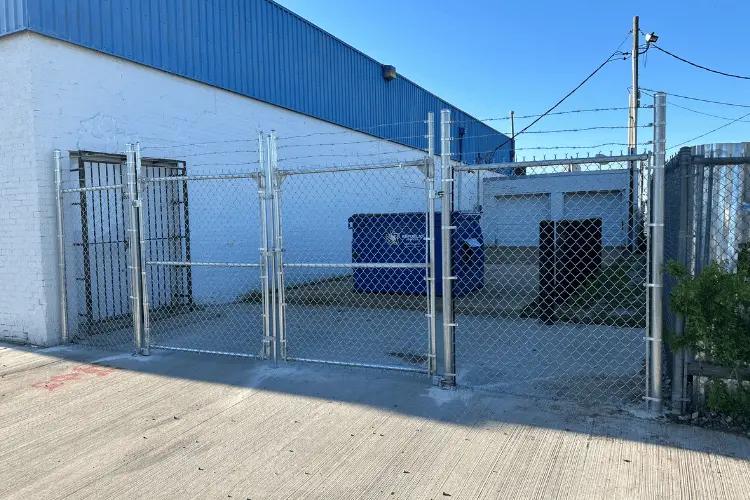
Heavy-gauge commercial chain link is the most common perimeter security fence, and for most sites it does the job well and economically. Built taller and in a heavier fabric and framework than residential chain link, and topped with angled barbed wire, it forms a real barrier around yards, warehouses, and industrial sites.
Its advantages are cost, durability, and a see-through line that lets cameras and staff watch the perimeter. For the majority of commercial applications where cost matters and the threat is moderate, heavy chain link with a barbed top is the practical, proven choice.
Welded Anti-Climb Mesh (the Upgrade)
When a site needs more protection or a cleaner look than chain link, welded wire mesh (often called anti-climb mesh) is the upgrade. Its tightly spaced welded wires give fingers and toes nowhere to grip and resist cutting far better than chain link, making it much harder to climb or breach.
It also presents a more finished, professional appearance, which suits commercial frontages and facilities that want security without an industrial look. It costs more than chain link, but for higher-value or higher-risk sites, the added climb and cut resistance is worth it.
Steel and Palisade (High Security)
For the highest-risk sites, steel perimeter fencing, including palisade (vertical steel pales with pointed tops) and heavy ornamental steel, provides maximum deterrence and resistance. These fences are imposing, extremely hard to climb or cut, and common on utility, infrastructure, and critical-facility perimeters.
Steel is the premium tier in both protection and cost. It is chosen where a breach would be especially costly or dangerous, and where the fence itself needs to broadcast that the site is serious about security. For most businesses it is more than needed, but where it is warranted, nothing else matches it.
Ornamental Steel for Visible Frontages
Not every part of a commercial perimeter needs to look like a fortress. Along a street-facing frontage where customers and the public see the property, ornamental steel fencing provides real security in a more attractive, architectural form that reflects well on the business.
A common approach is to mix fence types around a site: an attractive ornamental or welded-mesh fence along the visible frontage, and economical heavy chain link with a barbed top along the back and side yards. That way the security matches the exposure of each area and the budget goes where it counts.
Height and Top Treatments
Perimeter security fences are taller than ordinary fences, commonly six to eight feet, because height is a basic deterrent to climbing. On top, angled barbed-wire arms or coils of razor ribbon raise the effective height and make going over the top hostile.
Top treatments are chosen for the site and what local code allows, since barbed and razor tops are restricted in many areas. The combination of adequate height and an appropriate top turns the fence line into a genuine barrier rather than a hurdle someone can simply hop.
Gates and Entrances
The gate is the intended way through the perimeter, so it demands as much attention as the fence. Commercial sites use heavy swing or cantilever slide gates matched to the fence, sized and braced for the traffic they carry so they keep swinging true and latching cleanly.
Gates that are sized, braced, and latched properly mean the perimeter closes cleanly every time and is not left standing open on a sagging leaf. Entrances are the weak point of most perimeters, so they are built to the same standard as the fence.
The Foundation: Built to Take Force
A tall, heavy perimeter fence is only as secure as its posts and footings. Larger posts set deep in substantial concrete, with braced corners and gate posts, are what let the fence resist wind, its own weight, and anyone trying to push or pull it down.
This is doubly true in Oklahoma, where a tall fence catches serious wind. We build the foundation to carry both the security load and the weather, so the perimeter stays up and stays tight rather than leaning or loosening over time.
Layering Fencing With Cameras and Lighting
The most effective security is layered, and the fence is one layer. A perimeter fence delays an intruder while cameras, motion detection, and lighting catch them in the act, and the fence layout itself can support this by keeping the line clear of blind spots and pairing with lighting.
Thinking of the fence as part of a whole security system, rather than in isolation, gets far more protection out of it. We design perimeters that complement the cameras and lighting a site already has or plans to add.
What Drives Commercial Fence Cost
Commercial perimeter fencing costs more than residential fence because of the heavier materials, greater height, and more robust construction, and the price scales with the level of security. Chain link is the most economical, welded mesh and ornamental steel cost more, and palisade steel is the premium tier.
Height, top treatments, gates, the length of the perimeter, and site conditions all factor in. Rather than quote a figure, we assess the site and provide a written commercial estimate, and we help match the security to the budget so you are not over- or under-building.
How We Build Perimeter Security Fencing
Metro Fence installs commercial and perimeter security fencing across the OKC metro: heavy-gauge chain link, welded anti-climb mesh, steel perimeter fence, barbed and razor tops, and security gates with built to your height, gauge, and code or insurer specifications and set on deep, concrete footings.
We assess the site, spec the right fence for each area, and build the foundation to carry it. See our security fence and commercial fence pages for more, and a free commercial estimate is always available.
Get a Free Commercial Fence Quote
We come to your business anywhere in the OKC metro, walk the perimeter and its security needs, and design a fence that actually protects it, matched to your risk and budget. Every install carries a one-year workmanship warranty.
Call us at (405) 767-4828 or request a free commercial quote to get started.
Good to Know
Frequently Asked Questions
It is fencing built to protect the boundary of a business or facility, deterring intruders and delaying a breach long enough for detection and response. It goes beyond marking a boundary, using heavier materials, greater height, top treatments, and secure, well-braced gates.
It depends on the site and risk. Heavy commercial chain link with a barbed top is the economical workhorse for most sites; welded anti-climb mesh adds climb and cut resistance and a cleaner look; steel and palisade offer the highest security. The best choice matches the protection to the actual threat.
It costs more than residential fence and scales with the security level: chain link is most economical, welded mesh and ornamental steel cost more, and palisade steel is premium. Height, tops, gates, and perimeter length all factor in. We provide a written commercial estimate after assessing the site.
Yes. We install heavy swing and cantilever slide gates matched to the fence, sized and braced for the opening so they swing true and latch cleanly under daily commercial use.
Keep Reading
Explore Our Fence Services